| Prev
|
Simple Steps (Part 1)
|
Next
TravelStrategies:*Chase Unlimited Combo/Table
A good first step towards cheaper and better travel is to upgrade the credit card you use for most of your purchases.
We highly recommend switching to the Chase Freedom Unlimited and Sapphire Reserve credit cards to earn more valuable rewards on your credit card spending and gain access to a several valuable travel benefits, such as free access to thousands of airport lounges.
Unless you travel a lot for work, it can take a long time to earn a meaningful quantity of travel reward points. But, if you get a good rewards credit card and use it whenever you can, you'll steadily build up large quantities of points you can use for free hotel nights, free airplane tickets, and other travel expenses.
For most people, the combination of the Chase Freedom Unlimited card and one of the two Chase Sapphire cards (which are designed to work together) provides the most valuable rewards for your spending. And unlike many other cards, the points you earn are very easy to use for free travel. By simply upgrading your current credit card, you'll receive more valuable rewards over the course of the year, which translates into more free travel.
In addition, the Sapphire cards provide valuable travel benefits that you can use for all your travels.
Benefits of upgrading your existing credit card to these two cards
We highly recommend that you make the effort to switch over to these cards. You'll reap the benefits for years to come.
- The Freedom Unlimited and Sapphire cards earn valuable and easy-to-use Ultimate Rewards points—the best type of credit card points for most travelers. Ultimate Rewards points are extremely flexible, valuable, and easy to redeem. You can transfer them to a dozen different frequent flyer programs to book award tickets on a hundred different airlines. And if you encounter any difficulty in using them for frequent flyer tickets, you can get tremendous value per point by using them for free nights at Hyatt hotels, or simply by using them like cash to purchase travel through the Chase website. They are great gateway to the world of award travel, while retaining the option to simply cash-out your points whenever you want. See more details below.
- For most people, the Freedom Unlimited card is the best general purpose reward card. Some credit cards earn more valuable rewards on specific category of purchases, such as gas or groceries; and some people could conceivably earn better rewards with one of your advanced options. But, for most people, the Freedom Unlimited card earns the most valuable rewards on everyday purchases. You'll receive 1.5x Ultimate Rewards points on every purchase. When used like cash, this can be the same as a 2.25% cashback card. When used for award travel, the reward rate is equivalent to about 2.5 to 5%, or even more.
- The Sapphire cards earns even better rewards on your travel and restaurant purchases. The more-expensive Sapphire Reserve version earns 3x Ultimate Rewards points on these two important spending categories, worth a minimum of 4.5%, and more typically worth 5 to 8%. The less-expensive Sapphire Preferred version earns 2x points, worth a minimum of 2.5%, and more typically worth 3.5 to 6%.
- The Sapphire Reserve provides free access to over a 1,000 airport lounges. The card entitles you to a free Priority Pass Select membership that provides access to airport lounges located all around the world, for you and up to 2 guests. While you won't have access to the most luxurious airport lounges, and there won't always be a lounge in the same terminal you'll be using, you'll often be able to spend the time waiting for your flight in comfortable chairs—enjoying free drinks and snacks, high-speed Wi-Fi, and abundant power outlets. For more details, see:
- When you use your Sapphire Reserve for travel purchases, you'll not only receive a great reward rate, you'll get the best free travel insurance benefits of any card. The Sapphire Reserve is one of the few cards that offers "primary" rental car coverage. Unlike most other credit cards, if you damage your rental car, you don't need to involve your personal auto insurance company.
You'll also get free lost and delayed baggage insurance, free trip cancellation and interruption insurance, and free flight delay coverage, when you use the card to pay for any portion of your flights. For more details, see:
The cheaper Sapphire Preferred version still provides primary rental car coverage and extensive travel insurance benefits, but has longer waiter periods before the delay coverage kicks in.
- The Sapphire Reserve even provides free towing and roadside assistance and a number of other "premium card" benefits. For roadside assistance, Chase will pay $50 to cover the cost of towing, jump starts, etc. (up to $200 per year). You just need to call 855-860-7978.
Some other benefits include a $100 credit for Global Entry / TSA Precheck fees (every 4 years), access to valuable extra perks via Chase's Luxury Hotel and Resort Collection, and an upgrade to National Emerald Club Executive status.
- You'll receive 65,000 to 75,000 Ultimate Rewards points just for signing up for the cards (and meeting the minimum spending requirement). If you spend $500 in the first three months with the Freedom Unlimited card, you'll earn 15,000 bonus points (the offers will say "$150", but you'll actually receive 15,000 points). If you choose the Sapphire Reserve card, you'll earn another 50,000 points with $4,000 in the first three months. If you choose the Sapphire Preferred, you'll earn another 60,000 points instead. To make meeting the spending requirements easier, get one card first, and then once you've earned the signup bonus, get the other card.
65,000 Ultimate Rewards points can be used like $975 in cash, is more than enough for a free flight to Europe or 2.5 flights within the United States, or could be redeemed for 5 to 8 nights at a downtown Hyatt hotel (in many major cities).
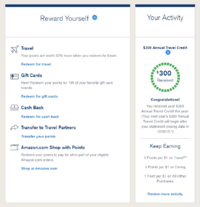
The Freedom Unlimited card doesn't have an annual fee, but the Sapphire Reserve has an extremely high annual fee of $450. However, this isn’t as bad as it first seems. The Sapphire Reserve comes with an automatic $300 travel credit. That means that the first $300 you spend on travel each year is automatically taken off your credit card bill. As a result, the $450 fee is essentially equivalent to prepaying for $300 of travel and paying $150 in extra fees. For most of our readers, airport lounge access, the high reward rates, and the other benefits of this combo, make this $150 money well spent.
More details about why you need to use these cards together
If you only have the Freedom Unlimited Card, the points you earn are normally only worth 1 cent each. Only people who also have Chase's Sapphire Reserve, Sapphire Preferred, or Ink Preferred credit cards can transfer Ultimate Rewards points to hotel and airline partners, or get more than 1 cent per point when purchasing travel through Chase.
But, these three cards only earn 1 Ultimate Rewards point, rather than 1.5x points, on non-bonus categories. So, you need the Freedom Unlimited card to get the higher point earning rate, and you need one of the other cards to get full value from the points you earn.
All of your Ultimate Rewards points go into the same account, so once you have any of these three cards, all your points become more valuable, even the points you earn from other Chase cards, such as the Freedom Unlimited card.
Of these three cards, the Sapphire Reserve costs more per year but provides airport lounge access and some other travel benefits. The other two cards cost less per year, but don't come scaled down benefits. For example, neither includes the airport lounge membership. The Ink Preferred is a small-business card.
TravelStrategies:*Chase Unlimited Combo/Box
Deciding which Sapphire card to get
To unlock the benefits of your Ultimate Rewards points, you'll need to get one of the Chase Sapphire cards (or the small-business Ink Preferred card). Otherwise, your points can't be transferred to airline and hotel programs and can only be redeemed for 1 cent each.
Depending on your circumstances, the Sapphire Reserve will cost between $25-145 more per year than the Sapphire Reserve.
- The annual fee on the Sapphire Reserve is an astonishing $550, while the annual fee on the Sapphire Preferred is a more reasonable $95. But, the real out-of-pocket cost of the Sapphire Reserve is much less than.
- The Sapphire Reserve comes with a $300 travel credit. The first $300 you spend on travel each year is automatically removed from your credit card bill. In other words, it gives you $300 of free travel purchases each year. This works on any kind of travel purchase, and happens automatically without any extra steps. Since, you'll be naturally using this card for all your travel spending, you should easily be able to take full advantage of the credit, dropping your out-of-pocket expense to $250 per year.
- The Sapphire Reserve also comes with $60 of automatic credits for Door Dash to use in 2020 and another $60 to use in 2021. Like the travel credit, the first $60 per year of Door Dash credits will be automatically taken off your bill. You'll also get a free membership in DoorDash's free delivery program. Depending on how much you expect to order from DoorDsash you can offset another $120 per year of the annual fee, making the card only a little more expensive than the Sapphire Preferred.
For the extra $25 to $145 per year, the Sapphire Reserve provides some extra benefits.
- If you value airport lounge access, you probably want the Sapphire Reserve version. Depending on your circumstances, the Sapphire Reserve will cost between $25-145 more per year than the Sapphire Preferred.
More details about the Ultimate Rewards program
Chase operates its own reward program called Ultimate Rewards. Due to its lucrative reward rates and extreme flexibility, this program is usually the best option for your credit card rewards. It is better than earning cashback, frequent flyer miles, or other types of credit card points.
- You can use your Ultimate Rewards points, like cash, to make a wide variety of travel purchases. When you purchase travel through Chase, you can use your points at 1.5 cents each. The Chase Travel website is powered by Expedia, so you can easily use your points to make airfare, hotel, and other travel reservations. Buying airplane tickets is a particularly good option, because the same fares and terms are usually the same everywhere. (If you frequently fly Southwest, you don't need to worry. You also have the option to get about the same value per point by transferring your points to Southwest Airlines's reward program.)
- You can often get even better value by using your Ultimate Rewards points for free Hyatt "award" nights. Ultimate Rewards allows you to instantly "transfer" your points to the Hyatt reward program, where you can use them for "free" hotel nights. For example, you could transfer 8,000 Ultimate Rewards points to Hyatt to book an award night at a nice Hyatt hotel, where the room rate might be $160 for a regular reservation. In this example, you'd be getting 2 cents in value for your points.
On many trips, you'll have good opportunities to get 1.75 to 2.5 cents or more per Ultimate Rewards point when you use them via the Hyatt program. When hotel prices are sky high for holidays and special events, having a stash of points you can use for hotel rooms is extremely valuable. For example, hotels in Hawaii, Ski Resorts, and Times Square require the same number of points during Christmas break or New Years Eve as they do every other day of the year. And you don't have to worry about black out dates and availability. If a standard room is available, you can always book it with points.
- You can also transfer your points to any of a number of different airlines to use for frequent flyer tickets. Through these programs, you can book frequent flyer tickets on over 100 airlines. For example, you can transfer your points directly to United to redeem for a flight on United or Lufthansa; or you can transfer to Air France to use for flight on Delta or Korean. For more details, see:
Truthfully, it is often frustrating and time consuming to find good opportunities to use frequent flyer miles, especially if you don't have a lot of flexibility with your travel dates and locations. However, when you do find an opportunity to book an award ticket, your can receive a lot of value from using your Ultimate Rewards points, dramatically reducing the total cost of a trip. And, if you're interested in booking a lie-flat business or first class seat on an international flight, frequent flyer miles are often the only reasonable option.
- If you decide to use your points for frequent flyer tickets, Ultimate Rewards points are usually much better than earning any specific type of frequent flyer miles, because you can use them with whichever of the dozen different programs works best for any given trip. That opens up more availability and, in many cases, allows you to choose a program that has a lower award cost or fees. Why earn United miles when your Ultimate Rewards points can be converted into United miles, but can also be converted into a dozen of other types of airline miles and hotel nights, or simply used as cash, if you can't find award space?
- Ultimate Rewards provides the ease-of-use of cashback, with the potential of a higher upside on free hotel nights and airplane tickets. For now, you don't need to worry about exactly what you'll do with your points. Just start earning as many Ultimate Rewards points as possible. In the worst case, you can get good value by using them to purchase travel through Chase. But, as you learn more about travel reward programs, you'll probably get more value by transferring them to partners to book award travel.
- Amex's Membership Rewards is also a very good program, but points can be hard to use. The only way to get good value from your Membership Rewards points is to redeem them for frequent flyer tickets. But, navigating the different frequent flyer programs and finding good award opportunities can be challenging. Unless you are, or are willing to become an expert, we recommend starting out with Chase Ultimate Rewards points.
Almost never use cash—earn rewards instead
Your goal is to collect as many rewards as you can. That means that you should use your reward credit cards whenever possible, rather than paying with cash, a debit card, or a check. Start putting everything on your cards, and your rewards will build up quickly.
- Every time you use cash, a check, or your bank card (when you could have used your credit card), you are missing out on reward points. Each individual transaction may not seem like much, but it adds up over time.
- Using a credit card, instead of cash, has some other benefits as well. You’ll have better records of your spending, build up your credit history, and make fewer trips to the ATM (paying less in ATM fees). In addition, your credit card will often give you some protection if something you buy breaks, is stolen, or even drops in price.
- While we strongly recommend using your credit card for as much of your spending as possible, you don’t have to take it to an extreme. If you are making a small purchase, and paying cash will speed up the process for everyone, don’t worry about a few cents worth of points. If you are under the store’s minimum for taking credit cards, don’t make a fuss, just pay with cash. And you usually don’t want to use your credit card with any business that will add on an extra "convenience" fee.
- Many of the bills that you pay each month can be paid with a credit card, rather than with a check or automatic bank withdrawal. For example, pretty much every wireless and cable company accepts credit card payments, as do many utilities, insurance companies, and gyms. Go back over a few months of bank statements, and see who you are paying on a regular basis. Then check which of these companies you can switch over to a credit card (without extra fees).
TravelStrategies:*Chase Unlimited Combo/Main
|